

 EN
EN RU
RU ZH
ZH KO
KO ES
ES FR
FR KZ
KZ UZ
UZКомпрессионный трикотаж в пожилом возрасте: почему важно учитывать возможность самостоятельного надевания
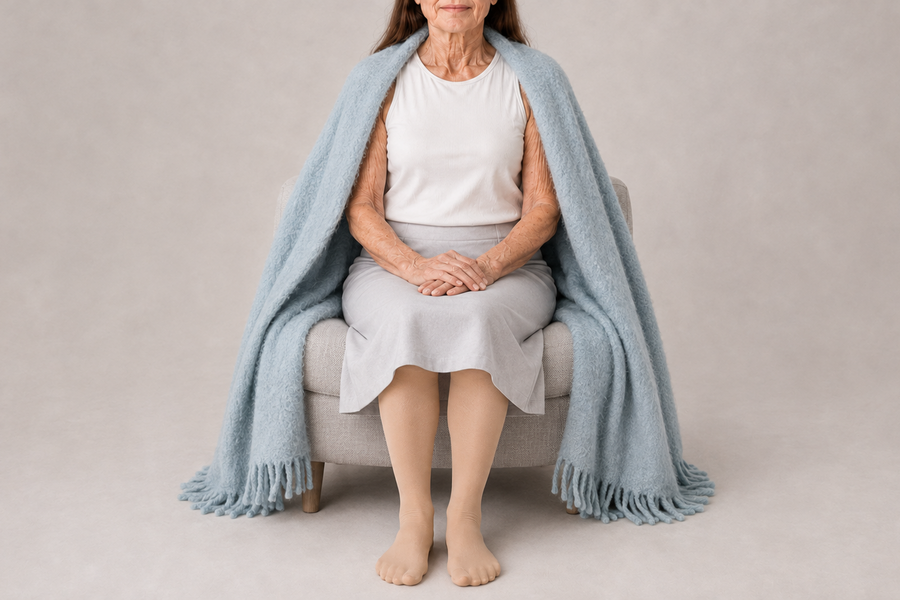
When choosing medical compression hosiery for an elderly person, it is important to assess in advance whether they will be able to put on and take off the garment independently. Reduced hand strength, joint mobility, or the ability to bend may hinder regular use even with the correctly selected compression class and size. The purpose, type of product, compression class, and wearing regimen are determined by the doctor, taking into account the patient's condition.
Old age itself is not an indication for compression therapy
Medical compression hosiery is prescribed not because of age per se, but in connection with certain diseases, conditions, or medical interventions. It creates distributed pressure: most pronounced at the lower part of the limb and gradually decreasing upwards. Before prescribing, it is important for the specialist to consider not only the condition of the veins but also possible contraindications and limitations.
Why compression hosiery can be difficult to put on
A medical compression stocking or sock cannot be put on like a regular sock. The elastic fabric exerts pressure on the leg, so it needs to be gradually and evenly distributed, without pulling from the top edge or leaving folds.
Self-dressing may be difficult if the person has:
- reduced strength in the hands and fingers;
- osteoarthritis or limited mobility in the hand joints;
- back pain or pain in the hip or knee joints;
- difficulties bending down to the foot;
- coordination and balance disorders;
- tremors or reduced sensitivity in the fingers;
- significant swelling or changes in the shape of the leg;
- vision impairments;
- cognitive difficulties that hinder the sequence of actions.
It is not the chronological age that matters, but the actual physical capabilities of the person. One elderly patient may use compression hosiery without difficulty, while another may require training, an assistive device, or help from a relative.
How the ability to dress independently affects product choice
If the patient cannot properly put on the prescribed hosiery, they may use it irregularly, leave folds, twist the fabric, or excessively stretch the garment. Therefore, the possibility of daily use should be discussed before purchase, not after difficulties arise.
What is useful to assess in advance
Before choosing a specific model, it is important to understand:
- Can the patient reach their foot and heel?
- Do they have enough strength and mobility in their hands?
- Can they put on the garment without losing balance?
- Do they understand the sequence of actions?
- Can they notice and smooth out folds?
- Will they be able to take off the garment independently?
- Is there someone who can regularly assist?
These questions do not determine the medical indication but help understand how feasible compression therapy is in daily life.
What to do if putting on is difficult
Difficulties with putting on do not mean that one should independently choose a lower compression class or a larger size. A larger-sized garment may fit incorrectly on the leg, and arbitrary reduction of compression may not correspond to the doctor's prescription. One cannot independently replace prescribed stockings with socks just because they are shorter and easier to put on. The upper limit of the garment is related to the localization of changes and the goals of compression therapy. The same applies to the compression class. The higher the pressure created, the more effort is usually required to stretch the fabric, but the difficulty of putting on is not a basis for independently changing the prescription. Possible solutions should be discussed with the doctor or a specialist trained in selecting medical compression hosiery.
Master the correct technique
First, the garment is turned inside out to the heel part, then accurately placed on the foot and gradually distributed along the leg. The compression stocking should not be gathered like an accordion, pulled only by the top edge, or left twisted. Training should preferably be conducted on the garment that the patient will use at home. This way, it can be immediately assessed whether all actions can be performed without assistance.
Use special gloves
Special gloves with a textured surface improve grip between the hands and the fabric and help gradually distribute it along the leg. This reduces the risk of damaging the compression hosiery with nails or jewelry. The Luomma Idealista range includes gloves for putting on compression hosiery, which can be used with socks, stockings, and tights. However, the gloves do not eliminate the need to bend down to the foot and require sufficient strength and mobility in the hands. Therefore, it is important to assess whether the elderly person can use them independently before purchasing.
Consider a donning device
If a person finds it difficult to bend down or distribute the tight elastic fabric with their hands, they might consider a Luomma Idealista donning device for compression hosiery. This is a metal frame onto which the stocking or sock is first placed. Then the patient places their foot inside the garment and lifts the device by the handles. The device can reduce the depth of bending and the load on the fingers; however, its use also requires certain coordination. The person needs to correctly position the hosiery on the frame, securely place the device, and smooth out the fabric after putting it on. Therefore, the ability to use the donning device independently should ideally be checked in advance.
Important: gloves and the donning device do not change the compression class, size, or type of garment prescribed by the doctor. Their purpose is to facilitate the correct donning of the already selected medical compression hosiery.
Organize regular assistance
If the patient is unable to safely put on and take off the hosiery independently, it is important to determine in advance who will help them. Occasional assistance does not always solve the problem if the doctor has prescribed a regular wearing regimen.
Size and fit are especially important when the shape of the leg changes
An elderly person may have different circumferences of the ankle, calf, and thigh. For example, a standard stocking may fit the measurements of the lower part of the leg but excessively compress the thigh. Buying the next size up does not always solve the problem: the garment may then be loose around the ankle, where the main pressure is formed.
The Luomma Idealista range includes compression stockings for wide thighs. Such models allow for increased thigh circumference without arbitrarily changing the other parameters of the garment. The necessity of a specific model and the correctness of the fit are assessed based on measurements and the doctor's prescription.
Why this is important when choosing medical compression hosiery
The ability to dress independently is an important but not the only criterion. The medical product must simultaneously meet the doctor's prescription, the anatomical parameters of the patient, and the conditions of use. Age should not be a basis for simplified selection. The task is to ensure that the prescribed product is correctly selected and practically applicable in daily life.
The company "Ecoten" has been producing medical compression hosiery for over 17 years. All products have Registration Certificates and are included in the "Register of Russian Industrial Products." Medical compression hosiery is produced in accordance with the requirements of GOST R 58236-2020 and GOST ISO 13485:2017. Any decisions regarding the prescription of compression products are made exclusively by the attending physician. This material is for informational purposes only. Follow our group on VKontakte.