

 RU
 ZH
 KO
 ES
 FR
 KZ
 UZ
Compression hosiery in old age: why it is important to consider the ability to put it on unaided
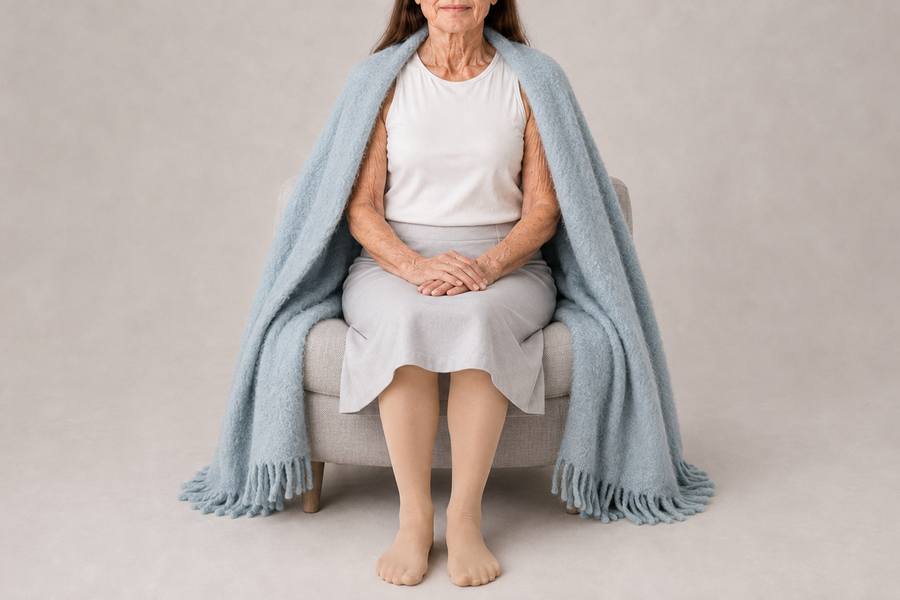
When choosing medical compression hosiery for an elderly person, it is important to assess in advance whether they will be able to put the product on and take it off on their own. Reduced hand strength, joint mobility or ability to bend down can make regular use difficult even with a correctly chosen compression class and size. The prescription, type of product, compression class and wearing regimen are determined by the doctor taking into account the patient's condition.
Old age in itself is not an indication for compression therapy
Medical compression hosiery is prescribed not because of age as such but for certain diseases, conditions or medical interventions. It creates distributed pressure: strongest in the lower part of the limb and gradually decreasing upwards. Before prescribing it, the specialist must take into account not only the condition of the veins but also possible contraindications and limitations.
Why compression hosiery can be difficult to put on
A medical compression stocking or knee-high cannot be put on like an ordinary sock. The elastic fabric exerts pressure on the leg, so it must be distributed gradually and evenly, without pulling it by the top edge and without leaving folds.
Putting it on unaided may be difficult if a person has:
- reduced strength in the hands and fingers;
- arthrosis or limited mobility of the joints of the hands;
- pain in the back, hip or knee joints;
- difficulty bending down to the foot;
- impaired coordination and balance;
- tremor or reduced sensitivity of the fingers;
- marked swelling or a change in the shape of the leg;
- visual impairment;
- cognitive difficulties that make it hard to follow a sequence of actions.
What matters is not the age in the passport but the person's real physical abilities. One elderly patient can use compression hosiery without difficulty, while another will need training, a donning aid or help from a relative.
How the ability to put the product on unaided affects the choice
If the patient cannot put on the prescribed hosiery correctly, they may use it irregularly, leave folds, twist the fabric or overstretch the product. That is why the possibility of daily use must be discussed before buying, not after difficulties arise.
What is useful to assess in advance
Before choosing a specific model, you should find out:
- Can the patient reach the foot and heel?
- Do they have enough strength and mobility in the hands?
- Can they put on the product without losing balance?
- Do they understand the sequence of actions?
- Can they notice and smooth out folds?
- Will they be able to take off the product on their own?
- Is there someone who can help regularly?
These questions do not determine the medical prescription, but they help to understand how feasible compression therapy is in everyday life.
What to do if putting it on is difficult
Difficulties with putting on do not mean that you should choose a lower compression class or a larger size on your own. A larger product may sit incorrectly on the leg, and an arbitrary reduction in compression may not match the doctor's prescription. You must not replace prescribed stockings with knee-highs on your own just because they are shorter and easier to put on. The upper border of the product is related to where the changes are located and to the goals of compression therapy. The same applies to the compression class. The higher the pressure created, the more effort is usually needed to stretch the fabric, but difficulty in putting it on is not a reason to change the prescription on your own. Possible solutions should be discussed with a doctor or a specialist trained in fitting medical compression hosiery.
Master the correct technique
First the product is turned inside out down to the heel, then it is positioned precisely on the foot and gradually distributed along the leg. A compression stocking must not be bunched up like an accordion, pulled only by the top edge or left twisted. Training should preferably be done with the product the patient will use at home. This way you can immediately assess whether all the steps can be done without outside help.
Use special gloves
Special gloves with a textured surface improve the grip of the hands on the fabric and help to distribute it gradually along the leg. This reduces the risk of damaging the compression hosiery with fingernails or jewellery. The Luomma Idealista range includes gloves for putting on compression hosiery, which can be used with knee-high stockings, stockings and tights. However, gloves do not remove the need to bend down to the foot and require sufficient strength and mobility of the hands. Therefore, before buying, it is important to assess whether the elderly person will be able to use them independently.
Consider a donning device
If a person finds it difficult to bend down or to distribute the dense elastic fabric by hand, they may consider the Luomma Idealista butler for putting on compression hosiery. It is a metal frame onto which a stocking or knee-high is first pulled. The patient then puts the leg into the product and lifts the butler by the handles. The device can reduce how far one has to bend and the load on the fingers, but using it also requires some coordination. The person needs to place the hosiery correctly on the frame, set the device down stably and smooth out the fabric after putting it on. Therefore it is advisable to check in advance whether the person can use the butler independently.
Important: gloves and a butler do not change the compression class, size or type of product prescribed by the doctor. Their task is to make it easier to correctly put on medical compression hosiery that has already been selected.
Arrange regular help
If the patient cannot safely put on and take off the hosiery on their own, it is important to decide in advance who will help them. Occasional help does not always solve the problem if the doctor has prescribed a regular wearing regimen.
Size and fit are especially important when the shape of the leg changes
An elderly person may have a combination of different ankle, calf and thigh circumferences. For example, a standard stocking may match the measurements of the lower leg but squeeze the thigh excessively. Buying the next size up does not always solve the problem: the product may then be loose at the ankle, where the main pressure is formed.
The Luomma Idealista line includes compression stockings for wide thighs. Such models make it possible to accommodate a larger thigh circumference without arbitrarily changing the other parameters of the product. The need for a specific model and the correctness of the fit are assessed according to measurements and the doctor's prescription.
Why this matters when choosing medical compression hosiery
The ability to put the product on unaided is an important but not the only criterion. A medical product must simultaneously match the doctor's prescription, the patient's anatomical parameters and the conditions of use. Age should not be a reason for a simplified selection. The task is to ensure that the product prescribed by the doctor is correctly selected and really usable in everyday life.
Ecoten has been manufacturing medical compression hosiery for more than 17 years. All products have Registration Certificates and are included in the "Register of Russian Industrial Products". Medical compression hosiery is manufactured in accordance with the requirements of GOST R 58236-2020 and GOST ISO 13485:2017. Any decisions on prescribing compression products are made exclusively by the attending physician. This material is for information purposes only. Follow our group on VKontakte.